How Accurate is Your Dashboard MPG Display?
Your car tells you how many miles per gallon you're getting, but can you trust it? We dig into how those displays work, when they're reliable, and when they're not.
All blog postsThe number on your dash - fact or flattery?
If you drive a car built in the last decade or so, you've got a fuel economy display staring back at you from the instrument cluster. Maybe it shows your average MPG for the current trip. Maybe it shows a live, changing readout that reacts the moment you press the accelerator. Either way, it's easy to take that number at face value.
But should you?
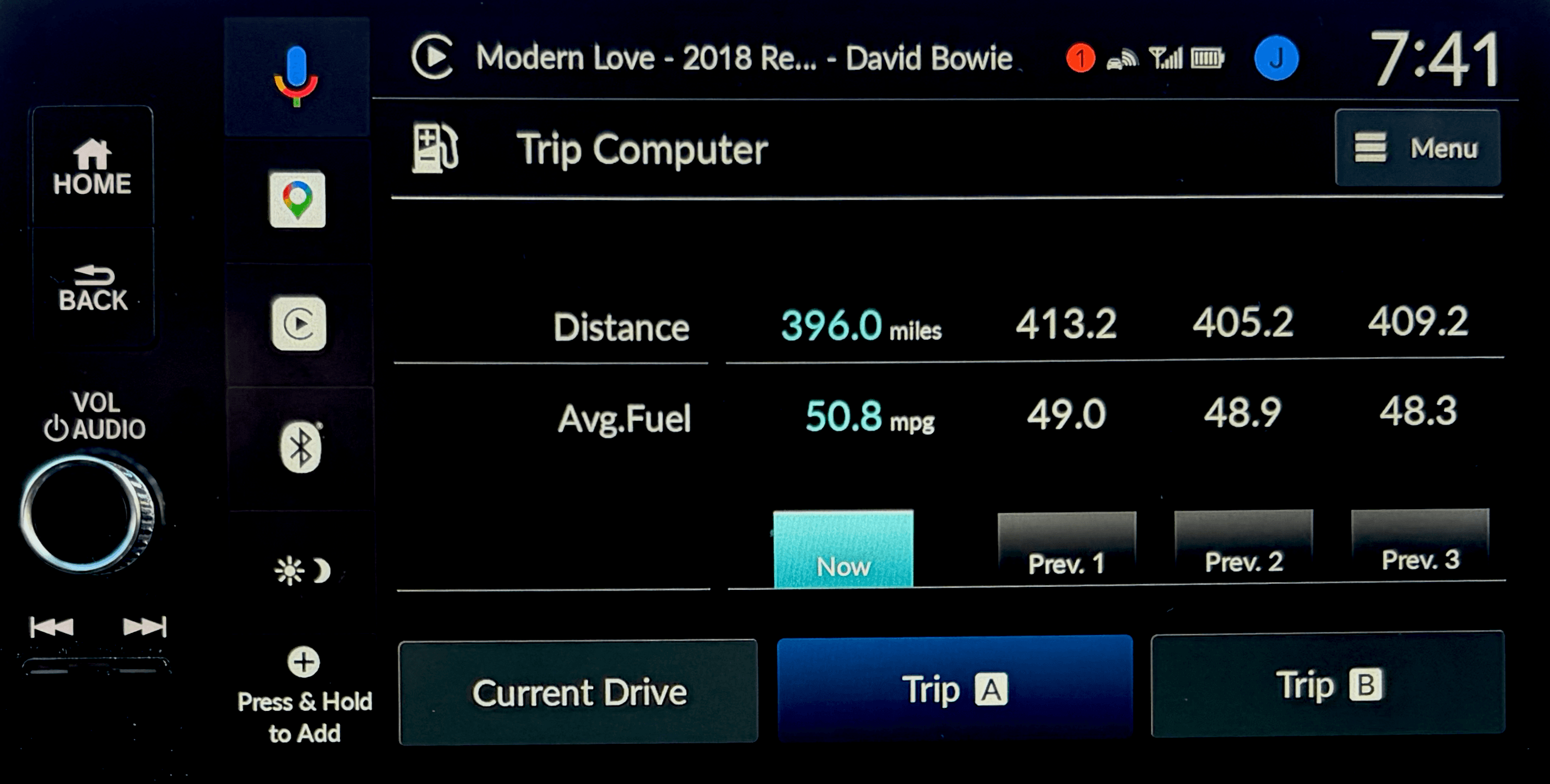
The honest answer is: it depends. Under the right conditions they perform remarkably well. Under other conditions, they can be meaningfully off and almost always in the direction that makes your mileage look better than it is. I've been tracking gas mileage for 20+ years and comparing to my cars' trip computer for half of that. Although I haven't historically recorded the latter, my 2025 Honda Civic Hatchback Hybrid recorded my previous three trips as getting 49.0, 48.9, and 48.3 MPG. SimpleFuel calculated these fill ups as 45.3, 45.8, and 44.3 MPG, lower than the trip computer by an average of 3.6 MPG, or 8%
Let's get into how they actually work, and what that means for how much you should trust them.
How the instantaneous MPG display works
The live, real-time MPG readout is calculated using two primary data streams from your engine's sensors.
The first is the Mass Air Flow (MAF) sensor, which measures how much air is entering the engine in grams per second. Modern engines maintain a precise air-to-fuel ratio of approximately 14.7 grams of air to every gram of gasoline, a chemically ideal ratio called stoichiometry. By measuring incoming air and knowing this ratio, the car's engine control module (ECM) can calculate how much fuel is being burned at any given moment. The second input is the Vehicle Speed Sensor (VSS), which tells the system how fast the car is moving.
Put those two together and you can calculate instantaneous fuel consumption. The math looks like this:
MPG = Vehicle Speed (mph) × 7.718 / Mass Air Flow (g/s)
The 7.718 is a conversion constant that accounts for the air-to-fuel ratio and the density of gasoline. Some vehicles also reference fuel injector pulse width directly as an alternative or supplementary method. This is essentially measuring how long each injector stays open per engine cycle.
This all happens many times per second, which is why the instantaneous display reacts in real time to your inputs. Coasting down a hill, the instantaneous MPG climbs. Slam on the gas, the instantaneous MPG plummets.
How the average / trip MPG display works
The average MPG display shows your efficiency over a trip or since your last reset, and works by accumulating the instantaneous readings over time and dividing total estimated fuel consumed by total distance traveled. In practice, it's a running average of all those per-second calculations described above.
Most vehicles allow you to reset this counter manually, and some will reset it automatically when you fill up the tank. (My Civic has this as an option in the Maintenance settings.) This is the number most commonly compared against real-world fill-up calculations, and it's also the one most studied for accuracy.
So how accurate are they, really?
In 2021, AAA conducted a rigorous study in collaboration with the Automotive Research Center (ARC) of the Automobile Club of Southern California, putting a selection of vehicles through a series of standardized driving scenarios on a dynamometer - essentially a treadmill for cars — while measuring actual fuel consumption against what the dash displayed.
The headline result sounds reassuring: on average, the tested vehicles showed an absolute error of just 2.3%, or about 0.7 MPG. At a displayed 30 MPG, a 2.3% error is less than a single MPG — genuinely not bad.
But dig into the details and the picture gets more complicated. Individual vehicle error in the same study ranged from -6.4% to +2.8%. That negative number matters: one vehicle overestimated its fuel economy by 6.4%, or about 2.2 MPG. The plus side means underestimating and your display says you're doing worse than you are. This was actually the case with 9 of the 16 vehicles included in the study, but other (less rigorous and more anecdotal) studies suggest that errors almost universally run in the optimistic direction.
Real-world testing from automotive journalist, BestRide, found that over hundreds of vehicles tested, in-dash displays were consistently optimistic, citing cases such as a Volkswagen TDI that showed 56 MPG on a careful highway run while fill-up math revealed 50.2 MPG, a gap of nearly 10%. A Land Rover tested by the same outlet showed 28.1 MPG on the dash while the math came to 25.4 MPG, again around 10% high.
Why do they tend to run high?
There are a few contributing factors.
1. The MAF sensor assumes ideal conditions. The air-to-fuel calculation assumes the engine is always running at that chemically ideal 14.7:1 ratio. In reality, during acceleration, cold starts, or hard pulling, the ECM deliberately runs a richer mixture (more fuel relative to air) to protect the engine and generate more power. The display may not fully account for these transient deviations.
2. Short trips skew the math. AAA's study noted that accuracy varies significantly over shorter trips. During a cold start, the engine burns more fuel before the catalytic converter reaches operating temperature and before the closed-loop fuel system kicks in, but a short trip ends before this inefficiency gets "averaged out."
3. There's no incentive to underestimate. This is the uncomfortable truth. Automakers know that consumers use these displays when shopping and when deciding how they feel about their car. A display that consistently flatters the driver is a feature that generates satisfaction. A display that makes you feel like you're getting less than you paid for generates complaints.
4. The fill-up method has its own quirks. To be fair, the manual fill-up calculation isn't perfectly clean either. How full is "full"? The nozzle auto-clicks off at slightly different levels every time. Temperature affects fuel density (gasoline expands and contracts roughly 0.069% per degree Fahrenheit, which can add up to a tenth of a gallon or more on a 15-gallon fill). Variations in the auto-shutoff mechanism between gas stations could lead to an additional fuel compared to your last "fillip." These factors introduce small but real noise into the manual method too.
When the display is reliable
The dashboard display earns its keep in a few specific scenarios.
Steady-state highway driving. When speed and throttle position are consistent, the MAF-based calculation is at its most accurate. There are no cold-start penalties, no rich-mixture transients, no stop-and-go cycles. This is why your highway MPG from the display is likely to be closer to reality than your city number.
As a relative indicator, not an absolute one. Even if the display reads 5% high, it's consistently 5% high. That means it's genuinely useful for comparing your driving style. You'll see real improvement when you drive more smoothly, accelerate more gently, or take a more efficient route. The trend is trustworthy even if the absolute number isn't.
On newer vehicles with better sensor calibration. The AAA study found meaningful variance between makes and models. The Mercedes-Benz CLA 250 in their test showed essentially no meaningful difference between displayed and measured fuel economy. Accuracy has improved as ECM software has gotten more sophisticated, and some modern vehicles are genuinely quite close.
The one thing it can't do at all
Here's the gap that no trip computer, no matter how sophisticated, can fill: it can't tell you that your fuel economy has been declining over time.
A car with a partially clogged fuel injector will still show you an MPG reading. It just won't tell you that the number is 3 MPG lower than it was six months ago, because it has no memory across fill-ups. It's measuring what's happening right now, not tracking a trend.
This matters more than it might seem. A gradual decrease in real-world fuel economy is frequently the first sign that something is wrong with your vehicle. A slow tire leak, a failing oxygen sensor, degraded spark plugs, or in more serious cases, issues with the fuel system itself. If you're only reading the dashboard, you'll miss it until the problem is much worse or you see that dreaded check-engine light come on.
The only way to catch this is to record your fill-up data over time and look for trends. Which is, not coincidentally, exactly what a mileage tracking app is designed to do.
The bottom line
Your dashboard's MPG display is a useful tool, not a precise instrument. Under consistent conditions it can get you within a few percent of reality, and it's a genuinely helpful real-time feedback mechanism for your driving style. But it tends to flatter you by 5–15% in many real-world conditions, it's least reliable on short trips and in cold weather, and it has no ability to tell you how your efficiency has changed over weeks or months.
For a quick sense of what you're doing right now? Trust it. For the full picture of your car's health and your actual cost per mile over time? You need to track your fill-ups.
Want to start tracking? SimpleFuel makes fill-up logging fast and simple, with support for gas, electric, hybrid, and plug-in hybrid vehicles.
-JK